A History Of Natural Slate Roofing and a Rubber Roofing Alternative
February 24, 2022
What Is Slate?
Slate is a fine-grained, homogeneous material excavated from the ground. It is derived from shale sediment composed of clay and volcanic ash that underwent low-grade regional metamorphism. It is durable, dense, and known as ‘virtually nonabsorbent.’ Like most natural products, the differences in chemical and physical compositions of slate can lead to varying colour, texture, and other characteristics. However, some grades of slate do have the ability to absorb moisture. Over time, this can lead to the deterioration of the roof deck’s components.When & Where Was Slate First Quarried?
The first-ever slate roof was a private home in North Wales around 1300 A.D. However, it was too costly and labour-intensive to source and install a slate roof back then. Therefore, most of the slate roofing was usually found on castles or other military structures only. In the 1800s, the Spanish created a quarrying process that worked efficiently to produce enough slate for everyday homes. This was a game-changing moment in the slate industry. Its dominance and expertise resulted in 90 percent of European houses using slate originating from Spain for roofing.Coming to North America
It was only in the late 1600s that slate roofing became available in North America. Initially, it was very expensive and only a handful of families and organizations were able to afford it. However, after the first quarry opened in the late 1800s, the slate was allowed to be made available to general consumers but in limited amounts. It was not until the second half of the 19th century, slate became mass quarried. To this day, Vermont is a major producer of North American slate. It is special in its composition, primarily an S1 quality stone. It comes in a rare variety of colours, including gray, black, green, purple, and red.Slate in Canada
In Canada, slate roofing flourished in the second half of the 19th century. It was stimulated by railway and urban development projects as well as architectural fashion. This made slate quarrying cost-effective with more slate roofs continuing to appear between 1900 and 1930. But, similar to Vermont and America, the slate market was reduced to wealthy clients due to increasing options of cheaper products. Slate: A Natural Fit Why was slate chosen as a roofing material when there are so many less costly options to pick from? The answer lies in the composition of slate that imparts its unique characteristics, which make it a natural fit for roofing. Its malleable breakability allows it to be formed into thin sheets with relative ease. On the other hand, slate is also extremely tough, making it a perfect covering for homes and other structures. Where other rocks would be too soft to provide protection or too hard to break, slate perfectly sits in a sweet spot between those extremes.Slate Roofing Repairs
AKRoN Roofing’s President and co-founder is well-versed in slate roofing. Rodney Gabrielson’s introduction into roofing began nearly 25 years ago with natural slate when he was trained and worked on the Balm Mansion in Pump Hill in SW Calgary. At the time, it was the largest in-city house in Canada and a three-year, all natural slate roof project. He later managed the slate roof installation of a French gothic-style 11,000 square foot cathedral in Kananaskis. AKRoN Roofing was founded with the idea that the same level of installation and attention to detail for high-end projects be applied to all homeowner’s projects. Slate roofing is susceptible to wear and tear with time, especially if it is old. Alberta’s heavy snow load can cause slate breakage, snow slides and dangerous conditions below a slate roof eave-line. In addition, it can be difficult to acquire replacement slate to conduct repairs that will match an existing slate roof. However, if a homeowner has a stockpile of extra slate pieces, AKRON Roofing can confidently help with slate roof repairs. With our roof measurement technology, such as GAF QuickMeasure and HOVER e360, we can provide on point roof inspection analysis and give you an estimate. Depending on the scope of work, we can perform repairs covering the damaged section or the entire roof, as required. Some typical defects on a slate-roofed building may include:- Cracked slate either vertically or horizontally
- Broken corners
- Sheet metal repair materials under the slate shingles
- Insufficient slate overlaps
- Holes due to incorrectly installed shingle units or iron deposits
- Delamination of slate resulting from mineral impurities
- Backed out or protruding fasteners
- Sealant repairs over defective slate
Rubber Roofing: A Slate Alternative Manufactured In Calgary
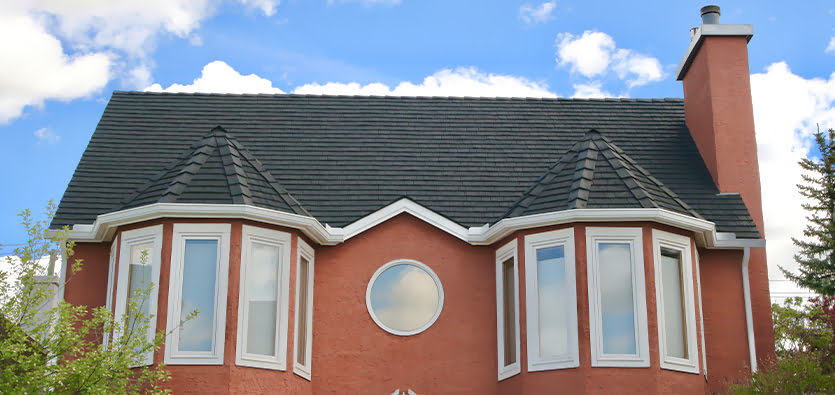
As discussed in the article, the slate roofing system has been in use for decades. However, like any other industry, the roofing industry is moving forward in lockstep with technological advances. Hence, over the past manhy years, several alternatives to the slate roof system have been developed. One of these is Euroshield’s Rubber Roofing which provides the aesthetic appeal of authentic slate but with the lightness of rubber, unprecedented durability, and comparative longevity. Euroshield Rubber Roofing has Slate options:Vermont Slate
Vermont Slate roofs are designed to provide you with a balance between beauty and protection. They have the rich texture, edge detailing and fine-grain features of real slate. In addition to this, they also provide protection against ultraviolet radiation, thermal expansion, high winds, hail storms and rapid changes in temperature.Rundle Slate
Rundle Slate, as compared to Vermont Slate, has a hint of old-world European luxury. They are designed for individuals who want to go for a rugged elegance look, and want longevity. They provide the appeal of upscale, extra-thick, chiselled-edge slate. These qualities are combined with the relative lightness of rubber and the guaranteed durability of a roof that will last a lifetime. Both Vermont Slate and Rundle Slate include:- Hailstone protection with unmatched Class 4 UL2218 Impact resistance.
- A 50-year warranty.
- Wind testing of up to 160 mph for two hours of continuous exposure at PRI Labs in Tampa, Florida
- Increased amounts of carbon black with the ability to absorb otherwise damaging ultraviolet rays